What Pressure-Treated Lumber Does After a Fall Deck Build in Raleigh, NC, And What's Normal
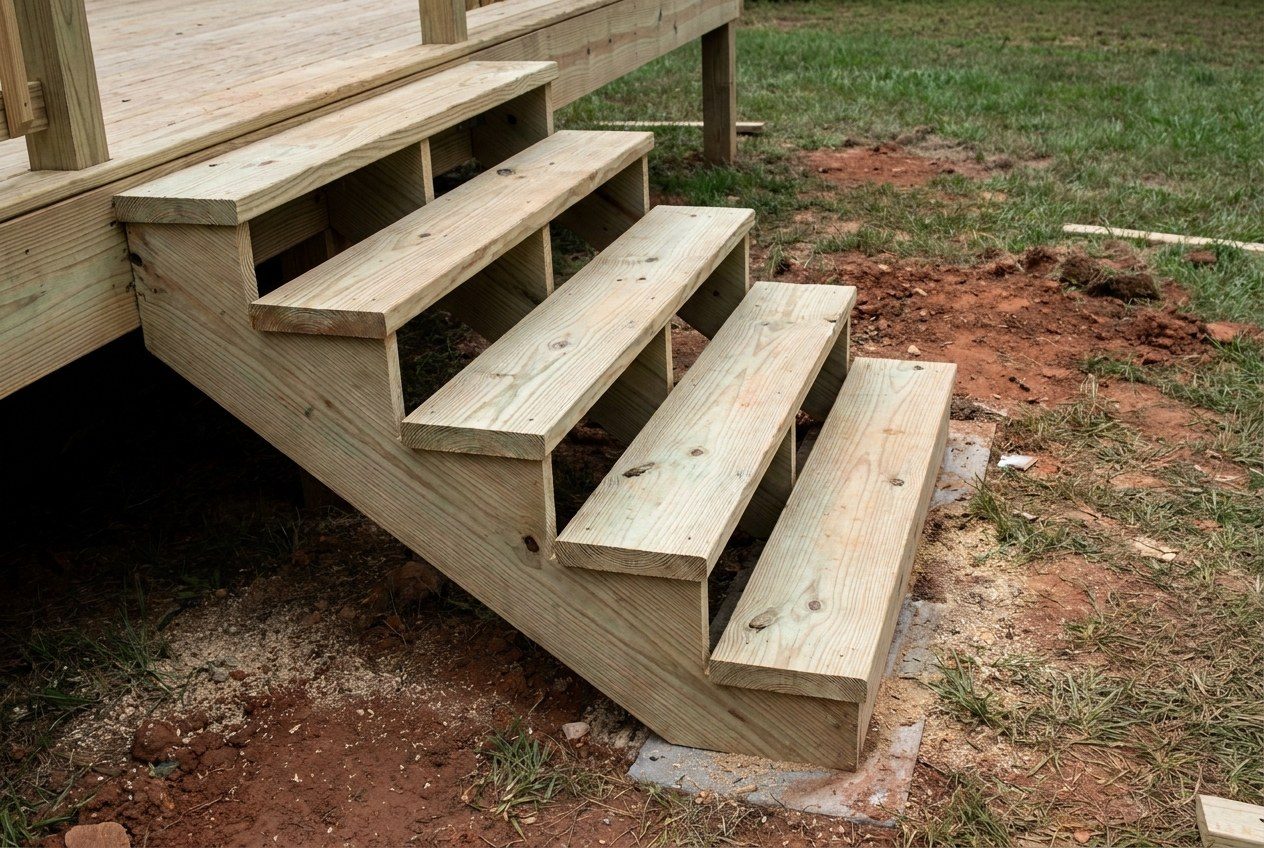
- Pressure-treated lumber continues to dry and move after installation, and fall weather in Raleigh, NC accelerates some of that movement in predictable ways.
- Surface cracks called checks are normal in pressure-treated wood and do not signal a structural problem on a new deck.
- Fall temperature swings and moisture changes cause wood to expand and contract, which is why experienced builders account for spacing and fastener choice before the first board goes down.
- Knowing what is normal after a fall deck build helps you avoid unnecessary worry and catch the few things that actually do need attention.
- A properly built deck accounts for seasonal wood movement from the start, so the lumber doing what lumber does does not turn into a repair down the road.
If you had a pressure-treated lumber deck built in Raleigh, NC this fall, you may already be noticing things you did not expect, small surface cracks, slight cupping, or gaps that look wider than they did the week the crew packed up. Before you call anyone, read this. Most of what you are seeing is the material behaving exactly as it should in Raleigh's transitional fall climate.
Understanding what is happening inside the wood, and why fall makes it more visible, helps you separate the normal from the fixable from the rare situation that actually needs a second look.
#What Is Pressure-Treated Lumber and Why Does It Move?
Pressure-treated lumber is ordinary wood, typically southern yellow pine, infused with preservatives under pressure to resist rot, fungal decay, and insects. The treatment process saturates the wood fibers with a water-based solution, which means the lumber installed on your deck often carries significant moisture when it goes down.
Wood is a hygroscopic material. According to the USDA Forest Products Laboratory Wood Handbook, wood continuously exchanges moisture with the surrounding air, shrinking as it loses moisture and swelling as it absorbs it. This is not a defect. Pressure-treated lumber, which starts out wetter than kiln-dried stock, does more of it in the first year or two after installation.
Fall in Raleigh, NC gives that process a push. Cooler air holds less moisture than summer air, and as temperatures drop through September and October, the lumber begins shedding moisture faster than it can reabsorb it. The wood responds by shrinking and moving.
#What Does Normal Wood Movement Look Like on a New Deck?
Normal movement looks like a few specific things, and recognizing them keeps you from misreading a healthy deck.
- Checking: Shallow surface cracks that run along the grain of the board. They form as the outer layers of the wood dry faster than the core, creating tension that the surface relieves by cracking. Checks rarely penetrate more than a fraction of an inch and do not compromise structural integrity.
- Slight cupping or crowning: A board may bow very slightly across its width as one face dries faster than the other. On a well-fastened deck, this is usually minor and often flattens out as the wood reaches a stable moisture content.
- Widening gaps between boards: If your installer spaced boards appropriately for wet lumber, the gaps may look larger once the wood dries and shrinks. This is intentional, not a mistake.
- Color change: Pressure-treated lumber turns from its initial greenish or yellowish tone to a silver-gray as it weathers. This is surface oxidation, not damage.
None of these are reasons for alarm on a deck that was built correctly. They are the lumber doing exactly what it was always going to do.
#How Does Raleigh's Fall Climate Affect This Process Specifically?
Raleigh sits in a transitional climate zone where fall is particularly active from a moisture standpoint. Summer humidity levels here are high enough that lumber installed in July or August has been absorbing ambient moisture even as it dries from the treatment process. When fall arrives and relative humidity drops meaningfully, the wood begins releasing that moisture more aggressively.
The daily temperature swings common in the Raleigh area through October and November add another layer. Wood that warms up during an afternoon in the 70s expands slightly. When temperatures fall back into the 40s overnight, it contracts. That cycling happens day after day through fall, and on a new deck where the lumber has not yet reached equilibrium moisture content, the movement is more pronounced than it will be in future seasons.
Equilibrium moisture content is the point at which wood has adjusted to its environment and stops gaining or losing moisture significantly. For outdoor lumber in central North Carolina, this typically settles somewhere in the range the USDA Forest Products Laboratory identifies for the Southeast. It usually takes one full seasonal cycle, sometimes two, for new pressure-treated decking to stabilize.
| Characteristic | Freshly Installed (Fall Build) | After One Full Season |
|---|---|---|
| Moisture content | High, still releasing treatment moisture | Lower, closer to equilibrium for the region |
| Surface checking | Common as outer fibers dry faster than core | Less active, existing checks stable |
| Board movement (gaps, cupping) | More noticeable with temperature and humidity swings | Reduced as wood stabilizes |
| Appearance | Green or yellow tone from treatment | Silver-gray weathered surface |
#How Do Experienced Builders Account for This During Fall Construction?
A builder who works with pressure-treated lumber regularly thinks about movement before the first board is fastened. Several practices separate a deck built with this in mind from one that treats lumber like a static material.
- Spacing for wet lumber: Because freshly treated lumber will shrink as it dries, boards installed tightly together will gap later. An experienced framer accounts for the starting moisture content of the lumber and spaces accordingly so the dried gaps land in a reasonable range.
- Fastener selection: Hidden fasteners and ring-shank nails hold better through repeated wood movement than smooth-shank fasteners. Screws designed for pressure-treated lumber, with coatings that resist the chemistry of the treatment, are a baseline expectation on a properly built deck.
- Joist orientation and crown direction: Framing members are installed with their natural crown facing up so that load over time works with the wood rather than against it.
- End-grain sealing: Cut ends of pressure-treated lumber absorb and release moisture faster than the treated faces. Sealing cut ends with an appropriate preservative at installation slows that differential movement.
These details are part of what distinguishes professional general contracting in Raleigh, NC from a rushed installation, the material's behavior is accounted for before it becomes a problem.